Working together towards a better understanding of Inclusive Growth in the Highlands and Islands

Contributed by Jonathan Hopkins (The James Hutton Institute), Andy Sarjeant (HIE) and Eilidh MacDonald (HIE)

As part of a project funded by the SEFARI Responsive Opportunity Initiative, researchers from the Social, Economic and Geographical Sciences Group at the James Hutton Institute and Biomathematics & Statistics Scotland have begun working with researchers, economists and policy staff within HIE’s Planning and Partnerships team, to create new knowledge about the characteristics of inclusive growth within the Highlands and Islands.

Inclusive growth is of high policy interest in Scotland. It is one of four priorities within the Scottish Government’s Economic Strategy and “…delivering inclusive growth across all of Scotland” has been highlighted in the Economic Action Plan for 2019-20. It is the key aim of Regional Growth Deals, and is an objective of City Region Deals and the Government’s strategy for island regions. More broadly, the UK is marked by major and growing regional inequality which will require widespread effort and considerable policy change to address. However, a recent review has noted that while a growing focus on inclusive growth by governments is a positive development, and its broad concern with the distribution of economic benefits is understood, it remains “…conceptually fuzzy and operationally problematic” and how it can be achieved is not well known. This is reflected by experiences in Scotland, as a report published last year for the Poverty and Inequality Commission described uncertainty among practitioners over the meaning and measurement of inclusive growth, noting bluntly that there “…is a lack of a clear, consistent or applied definition of inclusive growth”. The need for improved evidence and data around inclusion within rural Scotland is also apparent.

It is in this context that Highlands and Islands Enterprise (HIE): the economic and community development agency for the Highlands and Islands of Scotland, are interested in better understanding how their place-based activities and investments are contributing to inclusion. Discussions with social scientists at the James Hutton Institute with a collective experience in place-based policy and research in remote and island communities, as well as indicator-based analysis and an interest in measuring inequality, led to the ToWards Inclusive Growth (TWIG) project which started at the start of February.

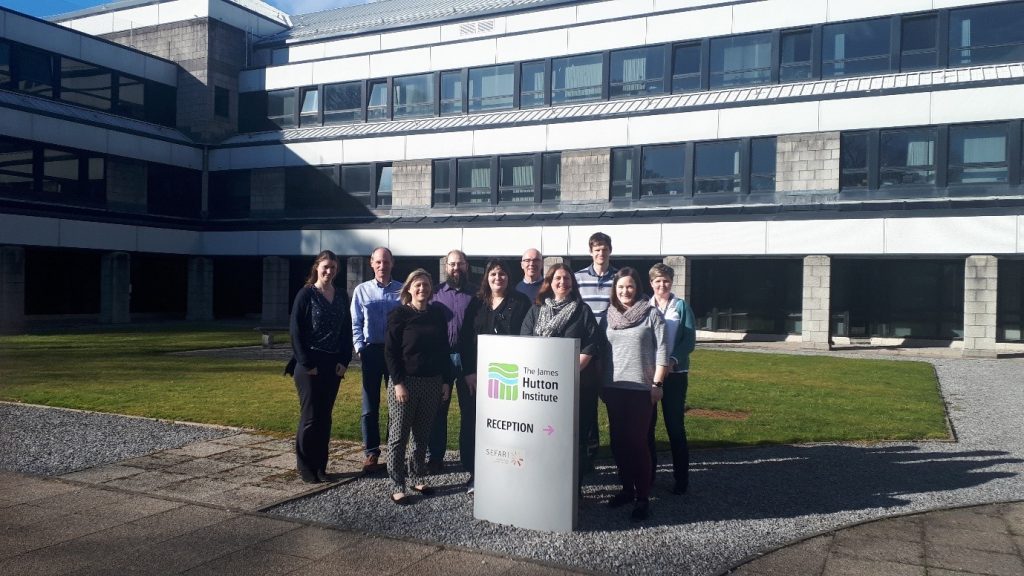
A key aim of the project is to support HIE’s development of a set of typologies for the Highlands and Islands that groups areas with similar characteristics in terms of inclusion and prosperity. Outputs from the project will include detailed area profiles reflecting local characteristics, informed by specific challenges and opportunities facing communities. Set against a wider economic context, the typologies and underpinning evidence base will provide a more granular picture of inclusive growth in the region and importantly will inform the interventions required to support inclusive growth over the long-term. To inform this work, and to support strategic research on place-based policy, a new cross-institute research and information-sharing network has been created between HIE, the James Hutton Institute and BioSS, and an engagement workshop was held on the 3rd March. During the workshop, facilitated discussions took place on participants’ current understanding of inclusion and inclusive growth, characteristics and frameworks needed to measure the concept, issues with data gaps and measurement, and the challenges presented by the geography of the Highlands and Islands. From these discussions, we collectively prioritised issues and identified key ‘SMART’ tasks to take forward within the project, in order to produce inclusive growth-based area profiles. The ‘after lunch’ session involved a planning activity, in which we defined a logical order for the tasks, and discussed how we will work together in the next one and a half months.
Image

Further engagement will take place in March. To formally conclude the project, the Highlands and Islands area profiles and ‘lessons learned’ from this work will be shared and discussed at an online event (timing and format to be finalised). This will benefit from the involvement of the Rural Policy Centre at SRUC and stakeholders and practitioners with an interest in inclusive growth; community and regional development organisations will be invited to participate.

The team are encouraged by a very positive and constructive workshop in Aberdeen, and we hope that our work will contribute to a greater understanding of inclusive growth in the Highlands and Islands, as well as across Scotland more widely, and inform improved policy and investment decisions. Further updates on the project will appear on https://researchontheedge.org/, but if you would like to discuss this project or would like any further information, please contact jonathan.hopkins@hutton.ac.uk and andy.sarjeant@hient.co.uk or eilidh.macdonald@hient.co.uk.


Can interactive maps help you understand your local community?

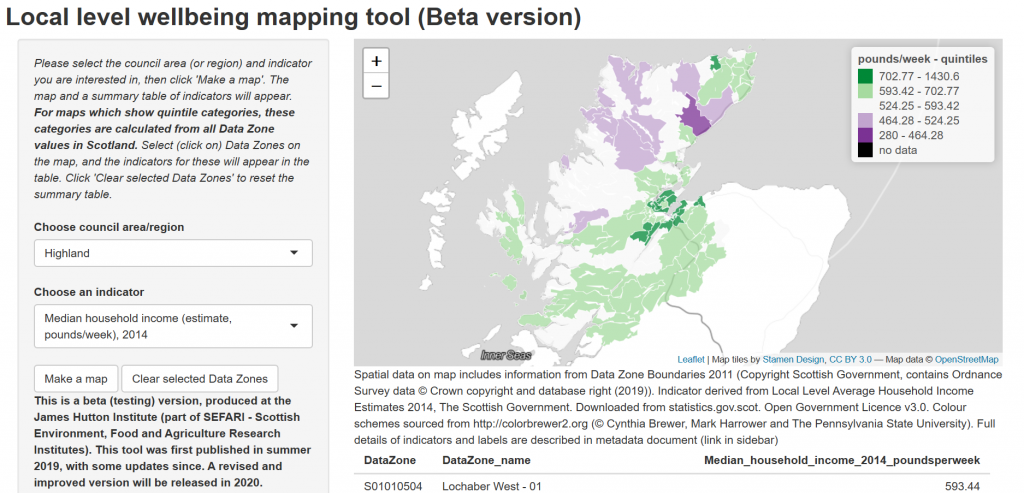
Jonathan Hopkins from The James Hutton Institute invites your feedback on an interactive map showing local-level indicators of wellbeing. Explore the map here, read the information sheet here, and take the survey here.

There are several reasons why access to detailed information about places and communities – for small areas well below the national level – is hugely valuable. In the context of inclusive growth and wellbeing, researchers at the OECD have made three relevant observations: firstly, the location where people live has a considerable influence on their quality of life and opportunities. Secondly, government policies are not implemented in the same way in all areas, and the decisions and investments of local policy makers (including Scotland’s councils) have a major impact on residents. Thirdly, country-level information often masks major inequality between regions.

The last of these three points is particularly salient, as issues of economic and social inequality are rightly high on the policy agenda, partly due to the correlation between regional decline and political populism. In February 2020, an independent academic inquiry into spatial inequality in the UK – the UK2070 Commission – published its final report. This highlights the cost of the extreme regional differences in wealth and investment within the UK, with strong development in London and urban areas in the south, contrasting with consistent difficulties experienced by northern cities and several smaller towns in older industrial areas and more isolated (often coastal) locations. In the context of threats and opportunities presented by future population growth and the urgency of reducing carbon emissions, the Commission has recommended radical and broad changes in areas such as governance, transportation, investment and housing policy.

Researchers in the Social, Economic and Geographical Sciences (SEGS) group at The James Hutton Institute are involved in research on place-based policies – development approaches designed for different local contexts through collaborative knowledge creation. As described by Jane Atterton, place-based policies in Scotland are not new, as urban regeneration schemes took place in the 1960s, but they have increased in popularity in the past decade. Modern place-based policies acknowledge the diversity of rural areas, and focus on improving several aspects of wellbeing. Place-based policies need to be designed and evaluated using a quality, spatially detailed ‘evidence base’: however, this is not always present in rural Scotland. More nuanced ‘place-sensitive’ policies have also been recommended more recently, which are “…tailored to the structural prospects of different kinds of European regions”: the need for these approaches to be informed by information and intelligence is clear.

As part of research funded by the Scottish Government’s RESAS Strategic Research Programme 2016-2021, we have evaluated how multiple dimensions of wellbeing (defined based on an established OECD framework) can be measured at the ‘local’ or ‘small area’ level, as part of our aim to understand the inequalities in socio-economic outcomes in rural Scotland. It is possible to represent a number of concepts via indicators at the Data Zone level, either through existing statistics or by calculating new indicators, although this is more difficult for concepts such as life satisfaction and environmental wellbeing. However, we have recognised that it is crucial to ensure that socio-economic data is usable and accessible to the diverse communities, practitioners and stakeholders engaged in place-based activities, as access to data supports informed decision-making and community empowerment. Our stakeholder survey, launched in winter 2018 following a workshop at the Scottish Rural Parliament, found that the current online resources for accessing and analysing data are not fully meeting the needs of end users, calling into question whether the benefits of ‘OpenData’ are reaching everyone. 

Last year, following the valuable engagement described above, we published an interactive mapping tool in ‘beta’ form which enables end users to produce maps of indicators developed during this research project for regions of their choice, and explore local characteristics. This application does not aim to compete with mapping resources such as the excellent SIMD tool. However, we would like to produce an effective and informative template for publishing multiple indicators and socio-economic datasets. The application was produced using open source software and an improved version could be adopted and developed further by other groups.  

In order to improve the tool, we’d be delighted if anyone would like to test the application and fill in a short, anonymous feedback form (https://hutton.qualtrics.com/jfe/form/SV_eLiNtsbakbhzFaZ). If you are interested, please take a look at the information sheet and explore the tool before providing feedback.

If you’d like any other information, or have any questions about our research, please contact jonathan.hopkins@hutton.ac.uk.